Donate to the Igs

Dead Duck Day 2020 kinda sorta postponed till 2022

June 4th, 2021

The 25th Dead Duck Day, on June 5th, which was postponed from 2020 until 2021, will be more or less postponed till 2022, due to the COVID-19 pandemic. So be on the lookout for the special (postponed) 25th anniversary edition in 2022.

This year, like last year, Dead Duck Day will have only two participants – me and the stuffed duck, accompanied by a bottle of beer, just as on the very first Dead Duck Day celebration, 26 years ago.

Kees Moeliker

Of course everybody is free and invited to have private Dead Duck Day celebrations, anywhere in the world, to commemorate the dramatic death of the duck — and the tragedy of billions of other birds that die from colliding with glass buildings.

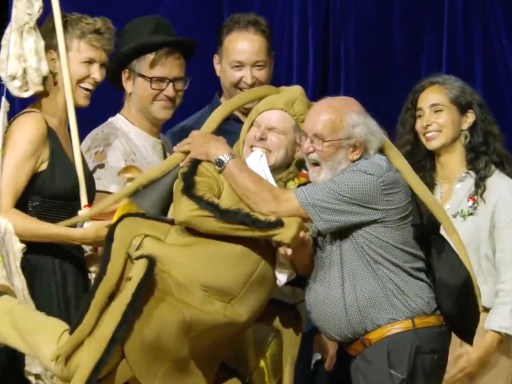
Here is a photo from a previous #DeadDuckDay, with a massive public gathering at Natuurhistorisch Museum Rotterdam, the site of the historic collision (photo by Maarten Laupman):

Nonetheless, a Joyous Day, This June 5, 2021

The good—not just good, but excellent—news is that June 5, 2021 is the day when the museum will be re-opening to the public, after a long closure because of the pandemic.

The number of visitors will be strictly limited because of Covid precautions. To go inside the museum on re-opening day, you can (and if you want to get in, you must!) book tickets in advance, online. And when you are there, pay your own personal homage to the carcass of the victim duck, which now resides permanently inside the museum with which it had that fatal, fateful, historic crash 26 years ago.

Ig Nobel Duck
The mallard duck that is a vital part of Dead Duck Day became known to science as the first (documented) ‘victim’ of homosexual necrophilia in that species, and earned its discoverer, Kees Moeliker, the 2003 Ig Nobel Biology Prize.

Low gravity looks at cats and pigeons and soldiers, and such

June 3rd, 2021

Some of the old experiments at or near the Air Force research labs in Dayton, Ohio, are on display in this video.

The video comes with this info, added by someone somewhere at some time:

Coverage of research at the Aerospace Medical Division HQ 657Oth Aerospace Medical Research Laboratories including scenes of F-104 seat ejection; drop tests from C-130 and ejection from F-106; effects of weightlessness on cats and pigeons in a C-131; test subjects in water tank, on centrifuge, in heat chamber and on complex coordinator. Also shows scenes of vertical deceleration tower, incline impact test facility, vertical accelerator, equilibrium chair and vibration platform.

Addition info, elsewhere, suggests the occurrences occurred in the year 1947.

A languid music video tribute to Ig Nobel Prize winners

June 2nd, 2021

Topster made this languid music video tribute to some of the Ig Nobel Prize winners:

https://www.youtube.com/watch?v=AP9p8qQ3XWA

Do Cats Eat Human Remains? [Improbable Research]

June 1st, 2021

What are your pet fears? The review column “Cats Research: Do Cats Eat Human Remains?” is a but one of many featured items in the special Forensics issue of the Annals of Improbable Research. The article is free to download:

Professor Bird won ornithology award [nominative determinism]

May 31st, 2021

The Doris Huestis Speirs Award is presented annually to an individual who has made outstanding lifetime contributions to Canadian ornithology. In 2017. the award went to Professor David Bird who is Emeritus Professor of Wildlife Biology and Director of the Avian Science and Conservation Centre of McGill University in Montreal, Quebec.

Research research by Martin Gardiner

Improbable Research